

PREMIUM DIESEL PROPULSION FOR MARINE PROFESSIONALS


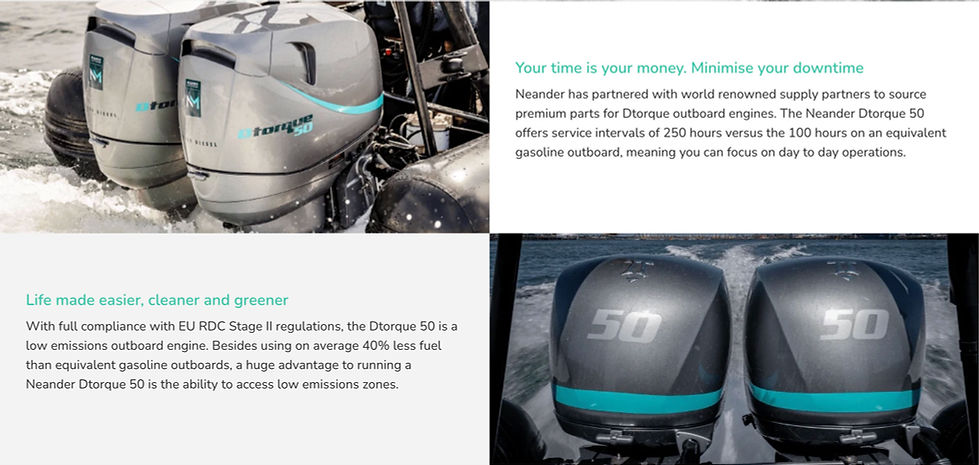
When selecting an engine to power your vessel, conventional wisdom often leads us to focus on engine horsepower (hp) as a primary indicator of boat speed. This approach holds true for gasoline engines and applications with minimal payloads, like motorcycles or cars.
However, the dynamics change dramatically when it comes to waterborne vessels. Vessels face substantial resistance from the water they displace, necessitating a unique perspective on engine performance. This is where the issue arises with gasoline engines, which typically exhibit low torque. Consequently, to access 30% power from a gasoline outbaord, you often find yourself revving up the engine to circa 60% of its capacity.
In fact, it’s common to experience a noticeable increase in engine power only when you surpass the 70% mark on the throttle.
This predicament becomes even more pronounced when dealing with heavier vessels, where the engine may struggle to exceed 70% to 90% of its maximum rpm due to a lack of torque. Consequently, what you believed to be a 90hp outboard engine may effectively deliver only 65hp in real-world applications.
INTERESTED in DTorque DIESEL OUTBOARD?
Send us your question and
we will get back to you as soon
as possible.
